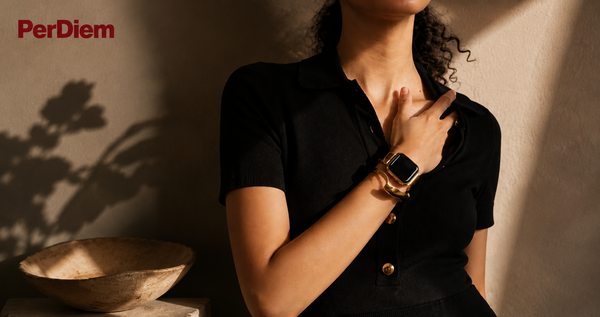
For most of its history, technology has made a simple, unspoken argument: function is enough. If it works, wear it. If it measures, use it. Aesthetics were an afterthought — a coat of paint applied after the engineering was done, if applied at all.
That argument is running out of time.
Where biometric sensing began
The history of wearable sensing is older than most people realize. The clinical forerunners of today's consumer biometrics were developed across the nineteenth and early twentieth centuries, driven entirely by medical necessity and with no consideration whatsoever for how they looked or felt.
The electrocardiogram — the ECG — was developed by Dutch physiologist Willem Einthoven in 1903. His original machine weighed 600 pounds and required the patient to submerge their hands and feet in buckets of saline solution to complete the electrical circuit. It worked. It was revelatory. It was also, by any measure, an experience to be endured rather than worn.
Blood pressure measurement followed a similar trajectory. The sphygmomanometer — the inflatable cuff still found in every doctor's office — was standardized in the early 1900s. Pulse oximetry, which measures blood oxygen saturation, was developed in the 1970s and refined for clinical use through the 1980s. These devices shared a common design language: utilitarian, institutional, built for function in controlled environments by people wearing white coats.
The implicit assumption was that biometric sensing happened to patients, in clinical settings, administered by professionals. The body was something to be measured. The person inside it was largely incidental to the design process.
The first consumer wave: function dressed up as fashion
The Fitbit, launched in 2009, was the first mass-market attempt to make biometric sensing something people would voluntarily wear every day. Its designers understood, at least partially, that a medical-looking device would not survive in the consumer market. The original Fitbit clip was small and relatively unobtrusive. Its successors became wristbands — simple rubber straps in neutral colors, designed to disappear against the wrist rather than announce themselves.
The design philosophy was essentially one of minimization: make the technology as small and inoffensive as possible so the utility could do the talking. It worked commercially. But it was not, by any serious measure, design. It was engineering with the rough edges sanded off.
The Apple Watch represented a genuine step forward in ambition. Apple hired Angela Ahrendts from Burberry and TAG Heuer's Patrick Pruniaux. It launched in Vogue. It was sold in Apple's retail stores next to Hermès editions with hand-stitched leather straps. The message was deliberate: this is not a gadget. This is a watch.
But the Apple Watch remained, in its essential form, a rectangular screen strapped to a rubber band. A computer wearing a watch costume. Its sensors lived inside a case optimized for display and processing, with an industrial design language inherited from consumer electronics rather than from the long history of objects made to be worn close to the body.
It measured beautifully. It did not yet belong on the wrist the way a well-made watch belongs there — as an object with its own presence, its own weight, its own relationship to the skin.
Why aesthetics were always losing the argument — until now
For decades, the constraints were real. Sensors required space. Batteries required volume. Processing required heat dissipation. The engineering demands of accurate biometric measurement genuinely conflicted with the demands of wearable elegance.
A heart rate sensor needs optical contact with the skin. An ECG needs electrodes. A temperature sensor needs thermal coupling. These are not arbitrary requirements — they are physics. And for a long time, meeting them meant accepting a form factor that looked like what it was: a device.
What has changed is the scale of the components. Photoplethysmography sensors — the optical sensors that measure heart rate and blood oxygen by shining light through the skin — have miniaturized dramatically. Flexible circuit boards can now conform to curved surfaces. Battery technology has improved energy density. Low-power Bluetooth and processing chips have shrunk to the point where meaningful computation can happen in a form factor the size of a shirt button.
The engineering constraints that once made aesthetic compromise unavoidable are dissolving. Not all at once, and not without tradeoffs — but dissolving nonetheless.
The emerging sensibility: sensing as craft
What comes next is not a better gadget. It is a fundamentally different category of object.
The designers and brands beginning to work at this intersection understand something that consumer electronics companies have been slow to internalize: the objects people choose to wear every day are not chosen for their specifications. They are chosen because they mean something. Because they feel right against the skin. Because they signal something about who the person wearing them is or aspires to be.
Jewelry has understood this for five thousand years. The wristwatch industry understood it for over a century — until the smartphone nearly destroyed it, and it survived by doubling down on craft, heritage, and the irreducible appeal of a beautiful mechanical object. Fashion has always understood it.
The next generation of biometric wearables will be made by people who understand it too.
We are beginning to see early signals. Oura moved sensing into a ring — a form with deep cultural resonance, minimal visual footprint, and a long history as an object of meaning. The ring does not look like a device. It looks like a ring. The sensing is invisible, embedded in an object that has its own reason to exist independent of its technology.
This is the design shift that matters: from technology that tolerates aesthetics to objects that embed technology without being defined by it.
The material question
What this evolution demands is a rethinking of materials. Consumer electronics are built from aluminum, plastic, silicone, and glass — materials chosen for their manufacturing properties, cost, and compatibility with electronic assembly processes.
Wearable objects with genuine aesthetic ambition are built from different materials entirely. Sterling silver. Gold. Ceramic. Titanium. Sapphire crystal. Stone. Leather of real quality. These are materials with tactile presence, with patina, with the capacity to age in ways that increase rather than diminish their appeal.
The challenge — and the opportunity — is engineering sensors into materials that were never designed to contain them. This requires collaboration between disciplines that have rarely spoken to each other: jewelers and electrical engineers, metalsmiths and materials scientists, fashion designers and firmware developers.
The objects that emerge from that collaboration will not look like anything that currently exists in either the jewelry case or the electronics aisle. They will be a new category — one that the market does not yet have good language for, because it has not yet had good examples to point to.
What the person wearing it actually wants
There is a woman — and she is not hypothetical — who wears her clothes with intention, who chooses her jewelry the way she chooses everything else in her life: carefully, with an eye for quality and a resistance to anything that feels generic. She understands what her Apple Watch does. She values what it measures. And she has made peace with the fact that it doesn't quite belong with the rest of what she wears.
She is waiting, without necessarily knowing she's waiting, for the object that closes that gap. The one that gives her the data without asking her to make a visual compromise. The one that was made with the same consideration for material and form that she brings to everything else.
That object does not require a choice between health and beauty, between information and elegance, between the body as a site of measurement and the body as a site of expression.
It understands that these were never actually in conflict. The conflict was a failure of imagination — one that the best designers, working with the best engineers, are only now beginning to correct.
The future is not wearable technology
The future is objects. Objects that happen to sense, that happen to connect, that happen to generate the kind of continuous biometric portrait that would have required a clinical research protocol a generation ago.
Objects made from real materials, by people who understand craft. Objects that accumulate meaning as they age. Objects chosen not despite what they do, but alongside it — where the sensing is one quality among several, the way water resistance is one quality of a well-made watch, present and reliable and never the reason you put it on in the morning.
That is where biometrics is going. Not toward better devices. Toward better objects.
The distinction is everything.